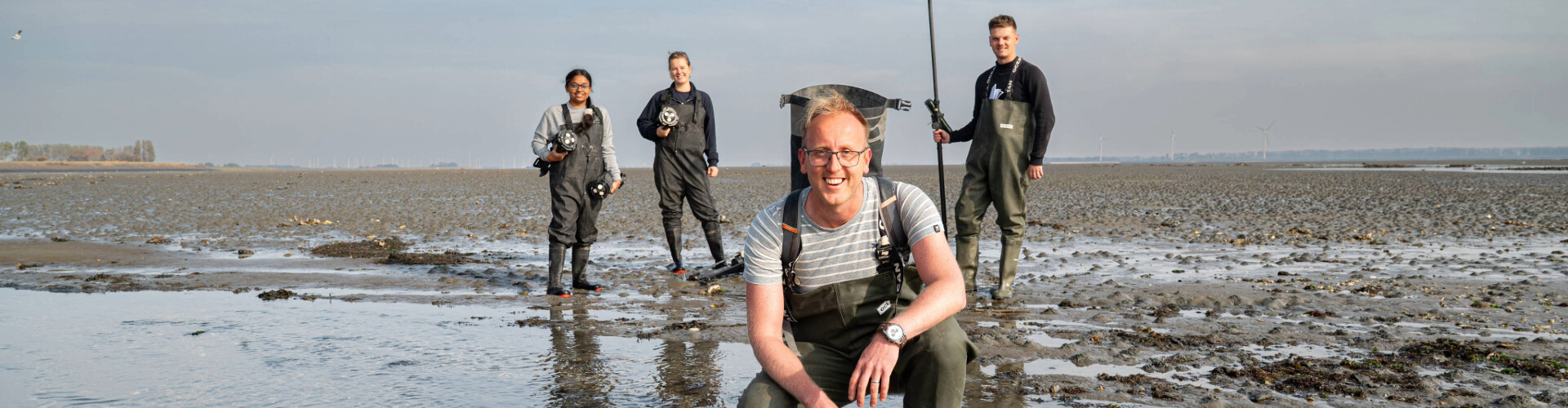
Over the past three years, Wietse van de Lageweg, Professor of Building with Nature, has spent half of his time at Rijkswaterstaat Sea and Delta working as a “professor at an institute” (see box). With one year to go, he explains what this collaboration has achieved for Rijkswaterstaat, the Building with Nature lectorate and his own professional development.
The name of the project is Future Shores. A broad perspective, too broad according to Wietse van de Lageweg, so he narrowed it down to the Oosterschelde and Veerse Meer. Natural materials and processes are the means to protect future coastlines, taking into account current and, above all, expected sea level rise. The project teaches him to look for solutions from a management perspective.
Sand hunger of the Oosterschelde
The problem with the Oosterschelde after the construction of the storm surge barrier is that the current in the system has decreased to such an extent that sandbanks and salt marshes are no longer being raised by sediment deposition, while they are being eroded by wave action. This process, which is causing the intertidal areas to slowly disappear, is known as sand starvation. Rijkswaterstaat regularly carries out sand replenishment to raise the sandbanks so that they do not “drown”. This preserves important natural functions for birds, for example. The sediment is extracted from pre-designated pits in the Oosterschelde and transported to the replenishment sites.
The Future Shores project focused on the foreshores in the Oosterschelde, the mud flats and salt marshes, which are also affected by a lack of sediment deposition, causing them to erode. Supplementation would also be a solution here, not with large quantities of sand from special extraction pits, but with dredged material that becomes available regularly and is now dumped in deeper parts of the Oosterschelde. 'Together with Civil Engineering students, I investigated how much sediment is released annually when keeping waterways open and dredging ports. And that adds up to a considerable amount. Enough to raise certain areas a little bit every now and then," says Van de Lageweg. The condition is that the quality is examined, especially of the fine silt that easily binds heavy metals.
Future Shores is made possible thanks to the L.INT programme. L.INT stands for “Lecturer positions at institutes” and is a subsidy scheme run by the SIA Executive Agency. Within the programme, Rijkswaterstaat acts as a knowledge institute, with which HZ collaborates to carry out the research. The two important partners from the professional field are the Scheldestromen Water Authority and Staatsbosbeheer. Future Shores will run until mid-2026. As a lecturer, Wietse also supervises students conducting research, through which Future Shores also contributes to the water experts of the future.
A sludge motor in Krabbenkreek
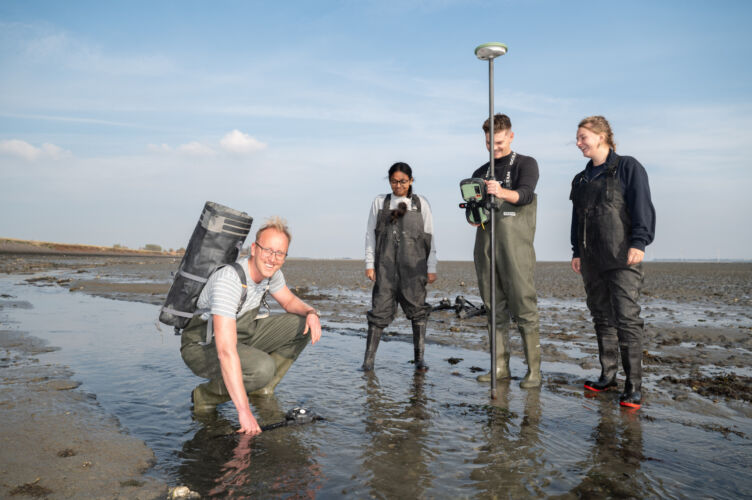
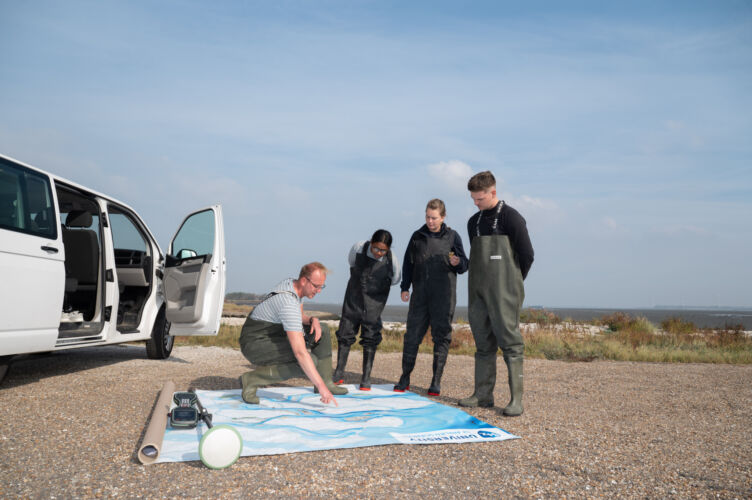
Most salt marshes in the Oosterschelde have a stone embankment to protect them from erosion, which means they are no longer naturally connected to the water system. In the Krabbenkreek, there is a small section of salt marsh without a hard embankment. Van de Lageweg and his students are investigating whether it is possible to supplement the salt marsh with sediment to dampen the current and thus slow down erosion. It is not simply a matter of dumping a load of dredged material in front of the salt marsh. The shape of the replenishment is important, as is the time of the tidal cycle when it is applied.
"Last year, students carried out a simulation that clearly showed what happens to the fine silt depending on whether you dump it at low tide or high tide." The replenishment could even provide sediment to allow the salt marsh to silt up naturally. "A kind of sludge motor," says Van de Lageweg, referring to the well-known sand motor that has been installed off Noordwijk in the North Sea. "That would be very innovative, but it needs to be worked out in more detail with other stakeholders, such as mussel fishermen, who are concerned about water turbidity."
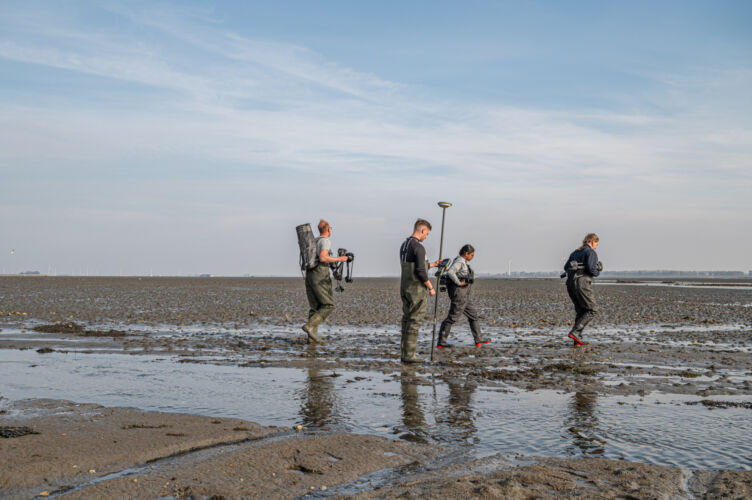
Slowing down erosion in Viane
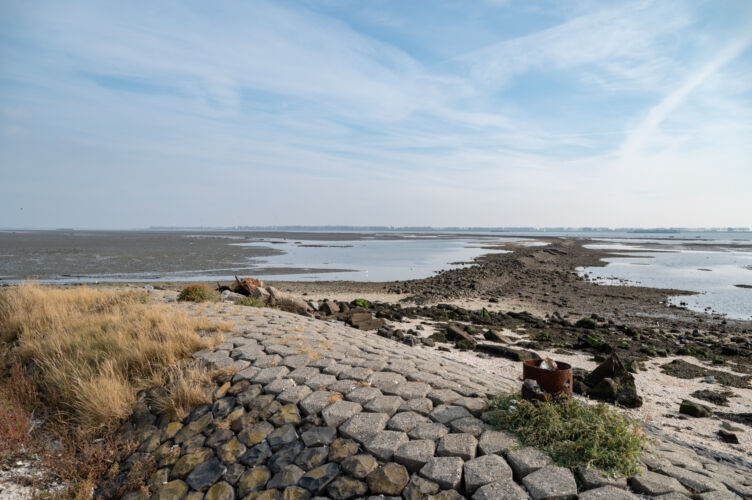
Off the coast of Schouwen, near the Watersnoodmuseum, lies Viane, a beautiful mudflat area with a small salt marsh. Here too, erosion is occurring at a rate of half a centimetre to a whole centimetre per year. "That may not seem like much," says Van de Lageweg, "but in flat areas like this, you can easily lose a lot of land in ten to twenty years." The Future Shores project is investigating the possibilities of slowing down erosion through nature construction, partly because the area is not currently included in the regular replenishment programme of Rijkswaterstaat, the Dutch Department of Waterways and Public Works.
"We are looking at how natural materials can be used to slow down erosion. An oyster reef was once constructed, but the location of the reef is crucial. High up in the tidal area, the oysters are exposed to dry conditions for long periods and do not grow well or even die; when the reef is lower, it slows down the current and thus does not sufficiently slow down erosion." He is considering small dams made of brushwood and woven willow twigs, which will be placed at various locations in the area. "In the Eems estuary, they are used to retain sediment. I would like to see if they can also slow down erosion." He has formulated an assignment on this topic for the master's students to work on this semester. "After all, it's still experimental."
Jellyfish infestation in the Veerse Meer
The Veerse Meer is the first water system to already be experiencing the effects of climate change, not in terms of water safety, because the Veerse Meer has no primary dykes, but in terms of water quality. Wietse van de Lageweg explains how this works. "The Veerse Meer is a nutrient-rich system that receives a lot of nutrients from the surrounding polders via the pumping stations. In the east, a culvert has been created in the Zandkreekdam, where exchange with cleaner Oosterschelde water takes place. When the sea level rises, there is less exchange because the level of the Oosterschelde rises, while that of the Veerse Meer must be kept at the same level. Together with a rise in summer temperatures, this leads to the proliferation of algae and jellyfish, for example, which causes odour and nuisance. Rijkswaterstaat refers to this as “jellyfish infestation”. This is not good for the “tourist product”."
The solution is to allow the water level of the Veerse Meer to rise in line with sea level rise, so that there is more exchange with the Oosterschelde. And that is where Future Shores comes into play again, because raising the water level means adapting the banks or even flooding certain areas. The latter will not happen with a few centimetres, but it will with a few decimetres to half a metre. "Currently, 90 per cent of the banks are hard, with stone or asphalt. If the water level rises and parts of it flood, large areas of wet land will be added, creating valuable nature. I therefore prefer to talk about an opportunity rather than a problem." He also knows that this cannot be done overnight. "Marinas with fixed jetties, farmers who have to deal with more saltwater seepage, villa owners on the water's edge – you will have to have a good conversation with each of them about additional measures such as extra drainage."
You can come up with all sorts of ideas, but what good are they if they are not feasible due to practical objections? The ecological aspect is only a small part of the solution.
The administrator's perspective
His time at Rijkswaterstaat not only provided him with many valuable contacts, but also taught him to view his profession from an administrative perspective. "I come from a scientific background. In the research group, we mainly focus on understanding a situation from a hydrodynamic and ecological perspective. In theory, it all makes sense, but the practical application is often limited. Thanks to my work at Rijkswaterstaat, I have started to think much more from a management perspective and am better able to weigh up all the interests involved.‘ And that is necessary to make an impact. ’You can come up with all sorts of ideas, but what use are they if they are not feasible due to practical objections? The ecological aspect is only a small part of the solution."
In just over a year, his appointment at Rijkswaterstaat will come to an end and he will return to HZ. ‘That's good for my visibility here and my work at the research group.’ Nevertheless, he already has ideas about a possible follow-up. "Perhaps a part-time appointment at a scientific institute such as Deltares. My colleague Hans Cappon, who works at Wageningen one day a week, benefits greatly from this in his work as a lecturer."

Building with Nature
The Building with Nature lectorate investigates how coastal defences can make maximum use of nature, so that they offer opportunities for recreation as well as safety.
Read more about this lectorate