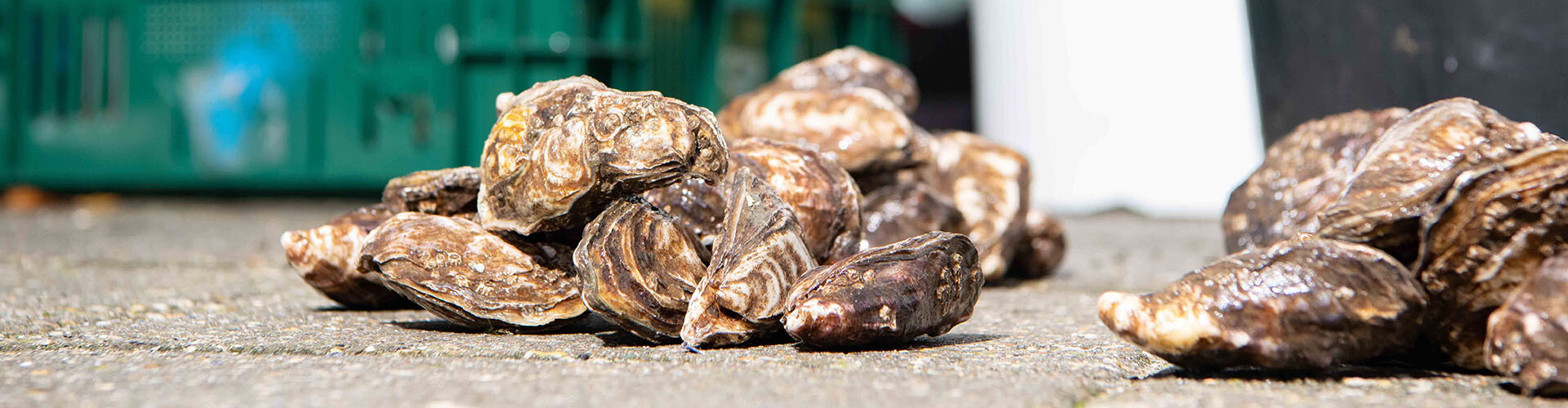
Oyster reefs were once abundant in European waters, but have now become rare. In Zeeland, the wild population of the native flat oyster (Ostrea edulis) has declined sharply in recent decades. Oysters, which thrive in large numbers on reefs, are essential building blocks of ecosystems. These reefs provide habitats for numerous other marine species and thus help to increase biodiversity.
Large-scale oyster restoration projects in the United Kingdom and the United States have shown that the creation of reefs leads to a significant increase in biodiversity, resulting in a substantial rise in catches of commercially valuable species. In the case of the waters off Zeeland, the restoration of an oyster reef would benefit various species, such as eels and lobsters. These species would benefit directly from the structures of a reef habitat, which would result in an increase in their populations and, consequently, higher catches. Furthermore, introducing a large biomass of Ostrea edulis would provide a boost to the wild flat oyster population, which could lead to an increase in spawning in the immediate vicinity. This offers opportunities for oyster farmers with plots in Zeeland’s waters, where declining spawning is a common problem.
To create such a reef on a large scale, Oyster Heaven has developed the Mother Reef. This technology consists of a clay substrate pre-coated with oyster larvae to kick-start the regeneration of a flat oyster reef and represents a completely new approach in the field of oyster reef restoration, where current techniques are often not scalable and are costly.
Ecological and economic added value
The pilot project was launched at the end of 2024. HZ is collaborating with the nature conservation organisation OysterHeaven (lead partner), Stichting Zeeschelp and Palinghandel Van de Kreeke to quantify the ecological and economic added value of the initial phases of an oyster reef restoration project. The project has the following objectives:
1. To establish a full-scale oyster reef using the Mother Reef substrate in Lake Veere.
2. To monitor the development of an oyster reef: survival rate, growth, reproduction, and the attraction of other reef inhabitants.
3. To increase knowledge of predators and other threats to oysters and to develop mitigation measures: oyster borers, jellyfish, seaweed, etc.
4. To document (1) ecological changes in the natural environment, such as improvements in water quality and biodiversity, and (2) the economic value of these changes, such as revenues from increased catches of lobsters, eels and flat oysters on cultivation beds.
The lessons learnt from this demonstration project will provide insights into how to extend restoration projects based on this approach to other waters in Zeeland, such as Lake Grevelingen and the Oosterschelde, where the reintroduction of flat oyster reefs will bring significant benefits for nature and economic activities (fishing and aquaculture).