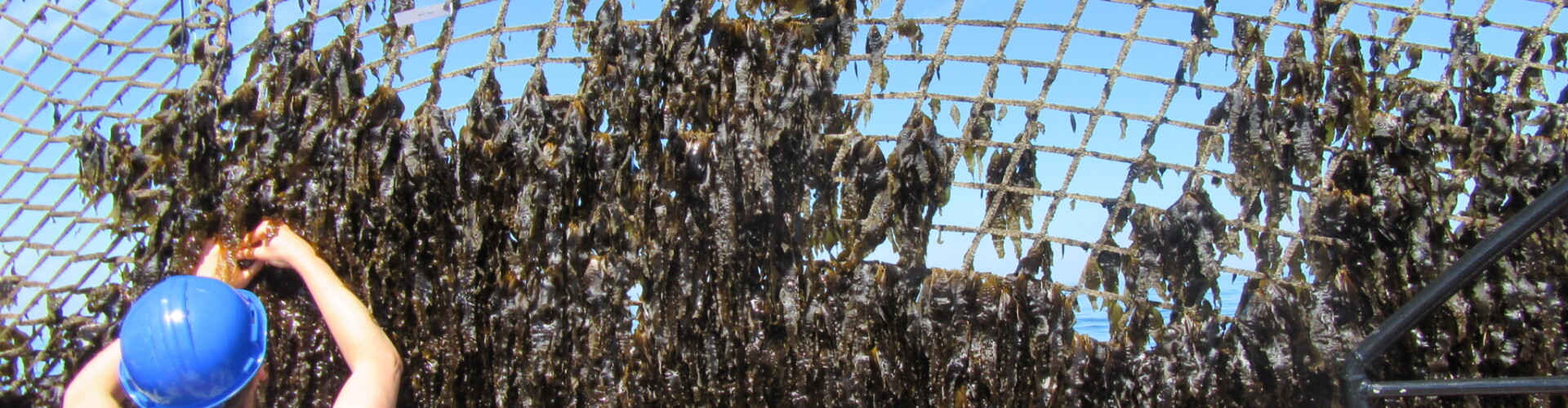

Offshore wind farms offer opportunities for multiple uses of space at sea. Wier & Wind 2 brings together Flemish and Dutch expertise to further develop seaweed cultivation in this environment and to make the step toward large-scale application possible.
Global demand for seaweed is growing, including for applications in food, animal feed, and bio-based materials. Seaweed also has a number of important advantages: its cultivation requires no agricultural land or fresh water, and it can contribute to carbon storage and nitrogen reduction.
Even so, large-scale seaweed cultivation in the North Sea remains limited for the time being. Production costs are high, existing technologies are not yet sufficiently adapted to the demanding conditions at sea, and viable business models are lacking. More knowledge is also needed about the effects of seaweed cultivation on biodiversity and other components of the marine ecosystem.
Offshore wind farms offer opportunities to use the available space at sea more efficiently. By combining seaweed cultivation and wind energy in a safe way, the same space can be used both to generate renewable energy and to produce marine biomass in a sustainable manner.
Objectives
Wier & Wind 2 aims to further develop seaweed cultivation in and around offshore wind farms and to test it under realistic conditions. To achieve this ambition, the project focuses on:
- making offshore seaweed cultivation more efficient;
- improving techniques for seeding, harvesting, and processing;
- helping to develop new applications for seaweed;
- investigating the impact on biodiversity and the marine ecosystem;
- developing feasible models for further scaling up.
In this way, the project helps take the step toward broader application of offshore seaweed cultivation in the North Sea.