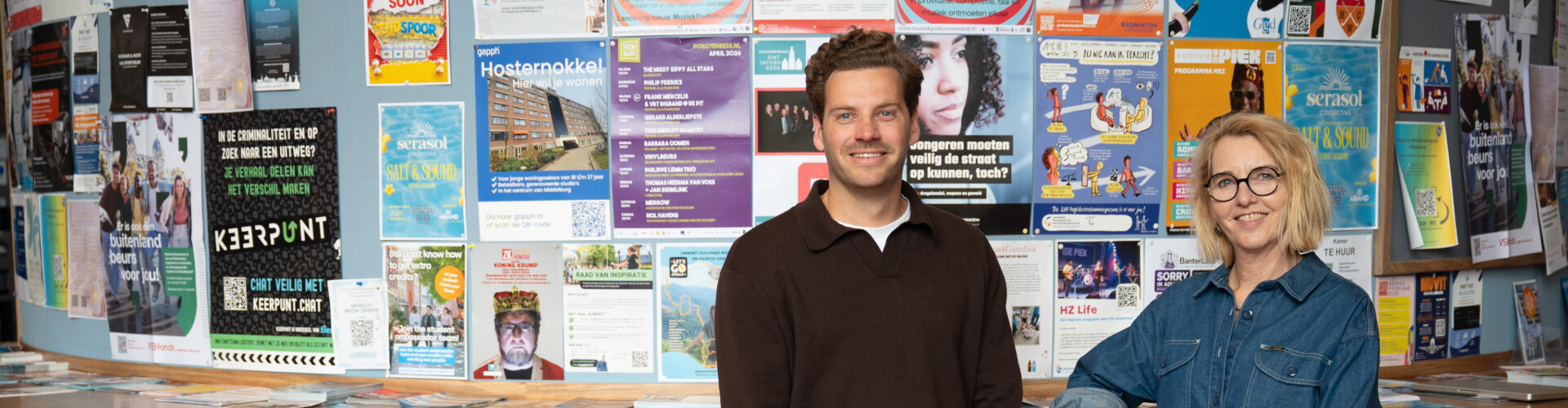
From the coming academic year, HZ will be launching HZ Explore: a revamped programme for students’ personal development.
Whereas students previously used HZ Personality to allocate their free credits, HZ Explore will soon offer a coherent and accessible range of activities for all first- and second-year students. Behind the scenes, the academic domains, supporting departments and HZ Community are working closely together on this change.
From individual activities to a coherent programme
HZ Explore builds on the foundations of HZ Personality, but provides greater structure, clarity and coherence. Students retain scope for personal development, whilst being offered a clearer range of options and well-defined learning objectives. “HZ Explore will offer all first- and second-year students a number of elective modules that are freely accessible to every student,” explains Huub Jagers, HZ Explore project member, HZ Community advisor and project manager at the Marketing, Communication, Community & Internationalisation Department (DMCCI).
Within the new programme, five free credits for bachelor’s students and 2.5 free credits for associate degree students remain available for personal development. Students can choose from around 44 different activities for this purpose. Meeting and connecting are central to HZ Explore. The learning objectives of HZ Explore are based on five dimensions of the Inner Development Goals (IDGs): being, thinking, connecting, collaborating and acting.
HZ Explore offers a wide range of activities that go beyond the three academic domains within HZ. “The activities range from sports development to immersing yourself in new cultures or new technologies,” says Huub. “It is precisely because activities are open to students from other programmes that new connections are formed.” According to Margriet Langenberg – van der Klauw, programme manager for Chemistry, this is precisely where the strength of the revamped programme lies: “HZ Explore really adds value by enabling students to forge connections and learn together across programmes and disciplines.”
Every student is given the same opportunity to develop themselves.
Equal opportunities for every student
A key principle of HZ Explore is accessibility. Whereas participation in HZ Personality sometimes involved a fee, all activities within HZ Explore are free for all students. This means that every student can take part, regardless of their background or financial situation. “Whereas students used to have to cover the costs themselves, there are now plenty of free places available for everyone,” says Huub. “Every student is given the same opportunity to develop themselves.”
A new role for assessment and support
A key difference from HZ Personality is that HZ Explore operates through clearly defined pathways, including assessments. Activities are no longer standalone components, but complete learning programmes with a start, interim check-ins and a final assessment.
The assessment has been deliberately kept accessible, as it concerns relatively small modules worth 1.25 or 2.5 ECTS credits. At the same time, those involved also see this as an opportunity for educational innovation. “We want to keep the assessment clear and relatively simple, but innovative,” says Margriet. “Perhaps that will also inspire lecturers to take a fresh look at assessment within their own teaching.”
For study programmes, HZ Explore also means greater clarity and fewer administrative exceptions. Previously, lecturers often had to discuss the allocation of students’ free credits with them individually. Now, activities, learning objectives and assessment methods are determined in advance. “Ultimately, this will also save programmes time,” says Huub. “A single, clear line is established in terms of activities and assessment.”
I’ve noticed a great deal of willingness within study programmes and departments to get involved with HZ Explore. It’s wonderful to see such enthusiasm.
Greater cooperation between the education and departments
HZ Explore is truly a joint project involving the entire organisation. In addition to the study programmes, various departments are also involved, such as timetabling, marketing and HZ Community. This is leading to new collaborations. For example, lecturers with a Basic Qualification in Assessment (BKE) certificate are being linked to HZ Community activities to ensure the quality of assessment. “Because lecturers are linked to HZ Community activities, new collaborations are also emerging between departments and domains,” explains Huub. “That’s a really positive development.”
Enthusiasm is also growing within the programmes. “I’ve noticed a great willingness within programmes and domains to get involved,” says Margriet. “It’s wonderful to see that enthusiasm.”
A programme with great potential
According to Margriet and Huub, HZ Explore stands out thanks to its strong focus on personal development, connection and a cohesive range of activities. “The range is so wide and inspiring that you sometimes almost think: it’s a shame colleagues can’t take part themselves,” laughs Huub. “Who knows, perhaps there’ll be room for that in the future too.”