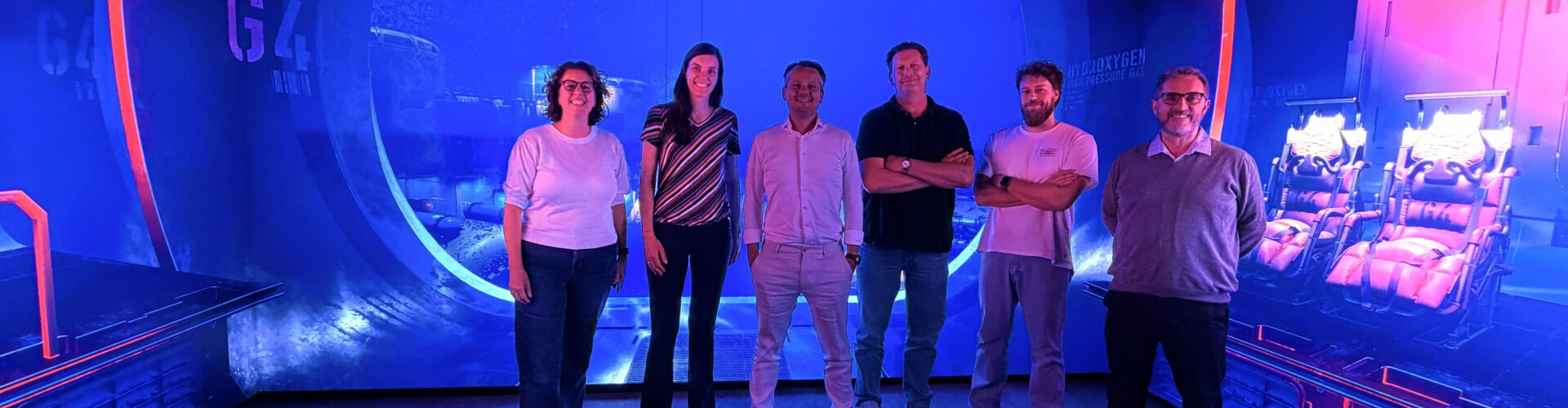
Last year, during the Comenius Festival, the Joint Research Centre Zeeland (JRCZ) won second prize in the Dutch Higher Education Award. The prize money of 800,000 euros will be used over the next five years to further develop the Zeeland education spectrum: the collaboration between students from vocational education (MBO), higher professional education (HBO) and university education (WO) at the JRCZ.
The award helps institutionalize the collaboration
The JRCZ received the award for the way in which students, lecturers, researchers and regional partners collaborate on societal issues relating to themes such as water, energy, food and the bio-based economy. “Until now, that collaboration has mainly taken place within individual projects and events,” says project leader Lilian Hoogwerf. “With this grant, we can develop these initiatives into a multi-year programme in which we structurally link education, research and practice.” The JRCZ is thus set to become an innovation lab for the educational sector.
"With this grant, we can develop these initiatives into a multi-year programme in which we structurally link education, research and practice."
Involvement of the education sector
Over the coming years, thematic clusters will be developed in which students, lecturers, researchers and industry partners will collaborate on a long-term basis to address regional issues. The first cluster falls under the theme of data science and intelligent systems and focuses on scenario planning and policy simulation. Students from Scalda, HZ and UCR are exploring how concepts such as systems thinking, group model building, storytelling, visualisations and immersive technologies can contribute to a better understanding of complex issues and the potential consequences of policy choices. In doing so, they are making use of, amongst other things, Scalda’s immersive classrooms. Serge Deurloo (Scalda), Josephine Pawsey (HZ) and Michael Burke (UCR) are currently holding discussions regarding the involvement of the educational institutions.
Shared facilities
A key aspect of the project is research into how we can shape collaboration across the education sector. This is being led by Patrick van Schaik, lecturer in Collaborative Learning and Development, and Petra Poelmans, practor at Scalda. It involves a participatory design study in which students, teachers, researchers and partners work together to develop, test and improve new teaching methods. The knowledge they gain must be translated into practical tools and methodologies that can also be used in clusters yet to be developed. In addition to the development of the thematic clusters, investment will be made in the coming period in shared facilities, knowledge-sharing, project organisation and collaboration with regional partners.
Alongside Lilian Hoogwerf, Patrick van Schaik and Petra Poelmans, the project team comprises JRCZ manager Leo Blok, Marco Lengton (HZ) and Alexei Karas (UCR).
What is an immersive room?
An immersive room is a form of eXtended Reality (XR): an umbrella term for virtual reality (VR), augmented reality (AR), and other forms of immersive technologies. In an immersive room, the physical and digital worlds are brought together to create a lifelike, interactive experience. Users are surrounded by the sights and sounds of a virtual reality to such an extent that they feel as if they are actually there.
An immersive room consists of a physical space with (often interactive) moving images projected onto three or four walls. Sometimes the floor and ceiling also feature (moving) images. Virtually all immersive rooms combine visuals with audio. Other elements, such as scent or wind, are sometimes used as well. (Source: Surf)