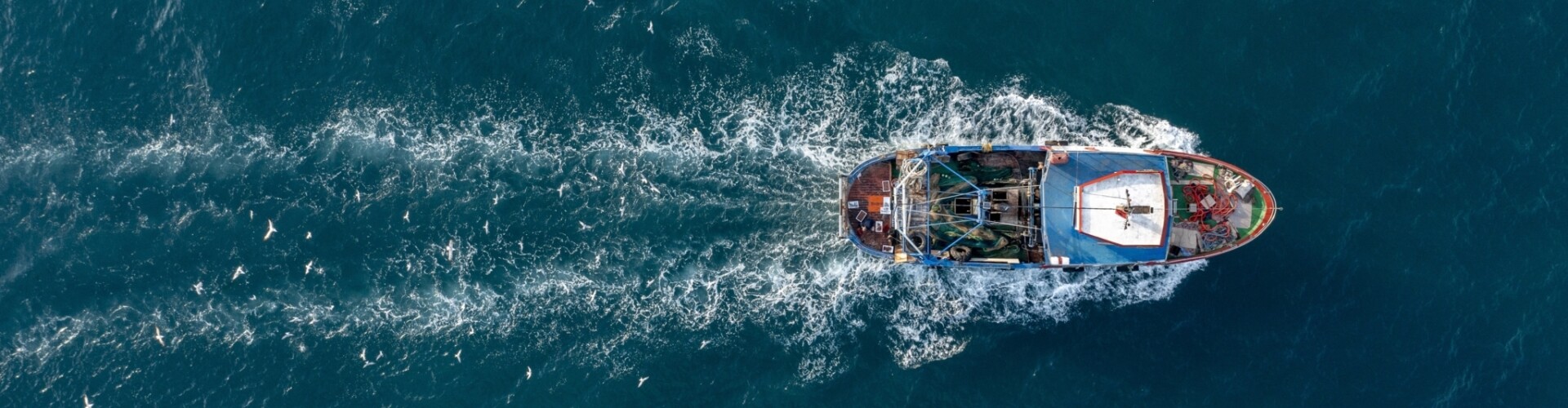
The new Vissi€nt research project is investigating how the fishing industry can save fuel. The project focuses in particular on social innovation and how we can ensure that fishermen actually adopt new ways of working. Professor Mischa Beckers’ Data Science research group is one of the partners in the two-year project.
The researchers are mapping out the behaviour and decision-making of fishermen, in collaboration with the fishermen themselves. This should clarify what fishermen consider important, what motivates them and how they work together. In addition, the project is investigating which technological innovations are feasible. It is important to assess how well these innovations can be implemented and what barriers exist to investing in them. Based on this, learning communities will be set up, where fishermen can learn from one another.
Largest cost item
Fuel is the largest cost item and the main source of emissions within the fishing sector. Although technological innovations, such as more efficient propellers and hybrid engines, are promising, their practical application is often limited. High investment costs and dependence on subsidies are major barriers.
However, there are also many opportunities to do things differently. Decisions regarding route planning, speed and the use of equipment are often based on experience and routine, but have a direct impact on fuel consumption. Savings can be made here quickly and with relatively little effort. Furthermore, the trade-off between fuel costs and catch yield is not always assessed rationally. To be able to do things differently, fishermen need to gain a better understanding of the social, economic and technical effects of their choices and be open to new ways of working.
Simulation models
The researchers will use simulation models to illustrate the impact of different choices. They are developing these models in collaboration with the fishermen. The researchers are doing everything they can to gain a better understanding of the decisions made on board. The simulation models provide insight into alternative scenarios by visually representing the effects on fuel consumption and financial outcomes. “We are trying to obtain as much data as possible directly from the fishermen themselves. Everyone knows that if you sail more slowly, you use less fuel, but there are other factors at play: the strength of the current, its direction, weather conditions, the equipment on board and how it is used, and so on,” says Beckers. “We want to shed light on how these factors and their interactions influence fuel consumption.” Once that is known, the researchers can develop scenarios for more fuel-efficient sailing. “But,” Beckers continues, “that’s not the end of the story, because a scenario might result in a longer journey time, less time for fishing and a lower catch. Saving fuel seems like a simple problem, but you need a great deal of data to create optimal conditions.”
As well as developing models, the researchers and fishermen are working together to build a learning community. Within this community, fishermen and students (as the next generation of fishermen) share their experiences and enrich existing knowledge with practical insights.