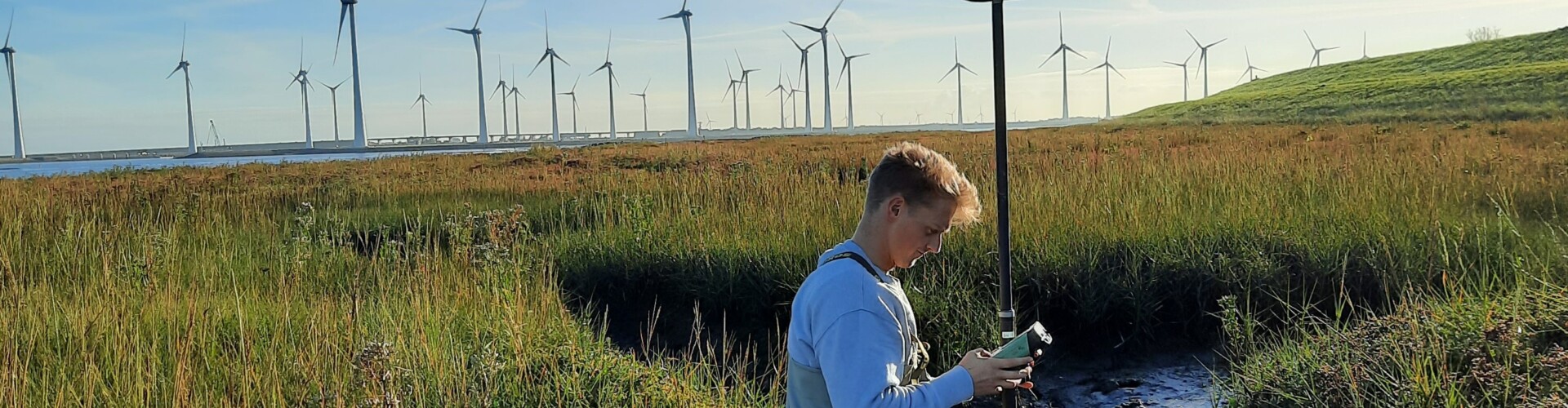
Universities of applied sciences will work with governments and practice partners in the coming years on solutions to issues surrounding water and soil. HZ University of Applied Sciences is the lead applicant of the project Perspective study on the flood defence zone. It is the first project within programme line 4 of the programme 'Practical knowledge for water and soil': 'A safe, resilient, accessible delta'.
The Netherlands faces a twofold challenge: protecting residents against flooding and restoring nature in large bodies of water. These two challenges are still often tackled separately. However, climate change, sea level rise and more extreme river discharges will bring new challenges from 2050 onwards. Nature-based solutions such as salt marshes, tidal flats, vegetated foreshores and biodiverse dikes offer solutions to both problems. Yet they are not yet commonplace, because their long-term value is not yet sufficiently visible and it is sometimes unclear whether they can be applied at certain locations.
Optimisation
The 'Perspective study on the flood defence zone' focuses on optimising high-water safety, nature and other functions in the flood defence zone in light of climate change. This perspective study forms the basis for four Living Labs, which accelerate applied research and education, together with regional and national partners in four flood defence landscapes: the coast, embanked rivers, embanked lakes and the urban flood defence zone.
“Making integrated trade-offs in a zone where space is scarce requires a transition to challenge-driven working across the responsibilities of different actors,” says professor Wietse van de Lageweg of Building with Nature at HZ. “There is no one-size-fits-all solution for all flood defence zones. The key lies in developing different scenarios of accelerated sea level rise and increased river discharge, in order to create regional water safety strategies and then translate these into local, area-specific and future-proof designs for the multiple use of space in flood defence zones.”
Tools for action
Through the project, governments and water managers will receive tools they can use to develop adaptive, spatial strategies for dealing with climate change. This will give them better insight into where and under which conditions these future-proof designs work. “In this project, we are constantly looking at whether what we learn in the region can also be applied elsewhere.”
Besides HZ University of Applied Sciences, HAN, Van Hall Larenstein University of Applied Sciences, Rotterdam University of Applied Sciences, Hanze University of Applied Sciences and Aeres University of Applied Sciences are taking part. Also participating are eight water boards, two provinces (Gelderland and Zeeland), the Zuidwestelijke Delta and Rijnmond-Drechtsteden regions, the municipality of Rotterdam, Rijkswaterstaat, RVO, Staatsbosbeheer (the Dutch Forestry Commission) and the Dijkzone Alliantie.
The project runs from January 2027 through December 2029. It is funded by Regieorgaan SIA, TKI Delta Technologie and the Ministry of Agriculture, Fisheries, Food Security and Nature (LVVN).
