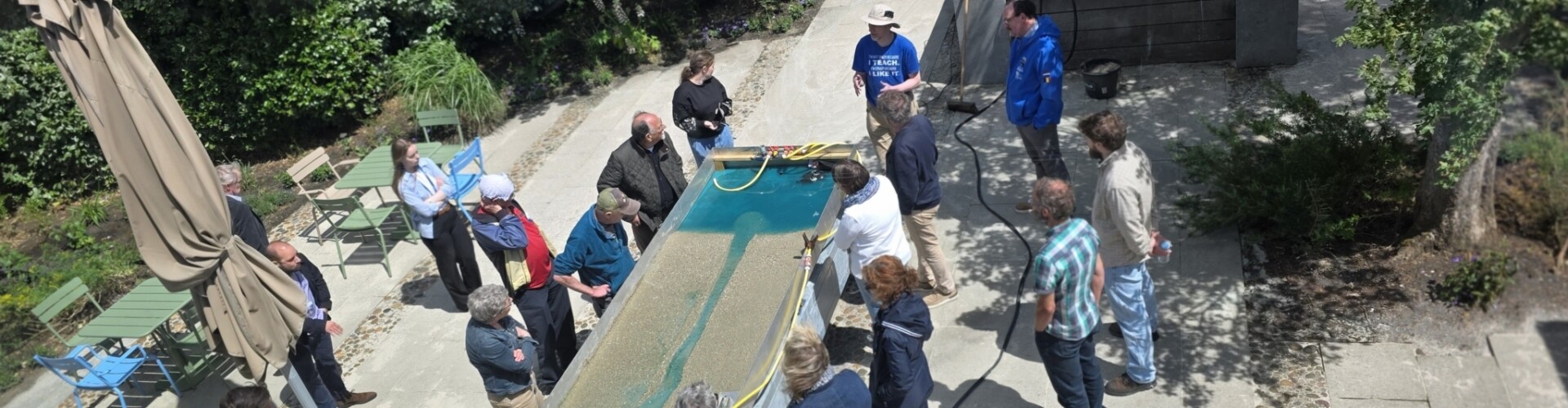
Deputy Harry van der Maas officially launched a mini metronome at the Watersnood Museum in Ouwerkerk on Tuesday, June 9th. It is a landscape table in which ebb and flow, currents, and sedimentation are made visible at literally thousands of times normal speed. The mini metronome is the result of a collaboration between the museum and the Delta Climate Center.
They are exploring ways to make knowledge about water, climate, and landscape accessible to a broad audience. "From young to old, always with the Flood Disaster in mind, but also with the question of how we all continue to survive after the disaster," said museum director Barbara Oomen. Van der Maas echoed this, saying that several things are coming together. "Here we don't just remember — we also build a knowledge region where research is conducted into topics such as climate adaptation, so that future generations can continue to survive after the disaster. The Delta Climate Center plays an important role in that."
Dikes and flood defenses
The mini metronome is suitable for primary school children as well as secondary school students and those in vocational, higher professional, and university education. Using the table, they can quickly grasp complex processes such as river dynamics, tidal currents, friction, and landscape formation. You can, for example, place a dike or flood barrier in the mini metronome to see what the consequences are for the landscape. "You learn by feeling. It is a landscape that moves, responds, raises questions, and invites research," said inventor Prof. Maarten Kleinhans of Utrecht University. "This is not a university metronome, it's a metronome belonging to Zeeland."
