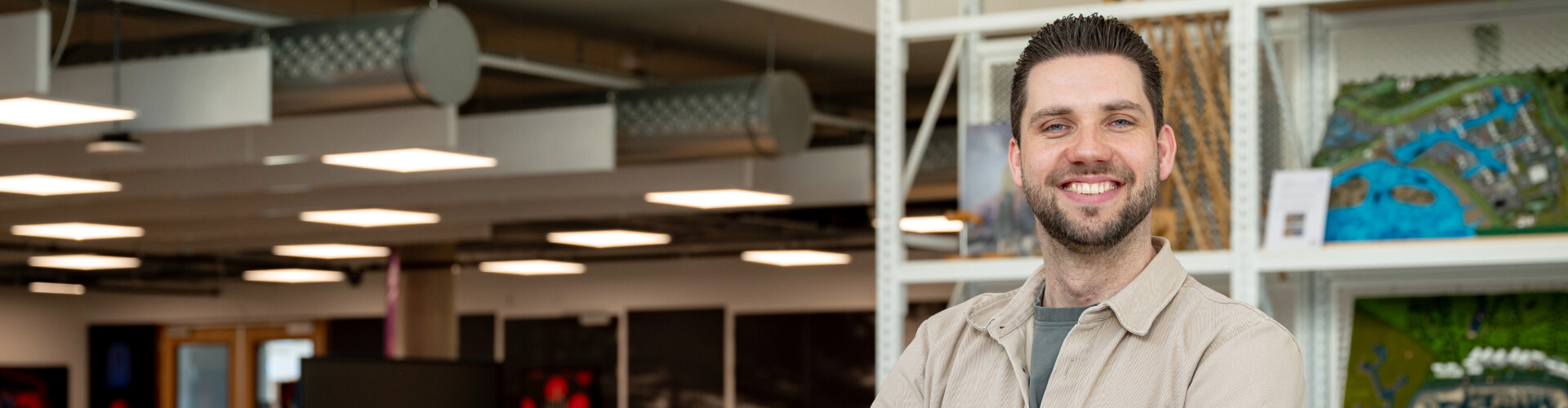
Gido Louwerse moved from Middelburg to Eindhoven to study Orthopaedic Technology at Fontys University of Applied Sciences. After spending around fifteen years in Brabant, a role as a teaching instructor brought him back to Middelburg last year.
Teacher in his own study programme
Even when he was working as an orthopaedic shoe technician, Gido knew he wanted to go into teaching one day. The plan was to gain ten or fifteen years of practical experience first, and then move into the classroom. It happened much sooner than he had anticipated: Fontys asked him to come and teach in his study programme. Alongside his practical job, Gido spent one day a week teaching future orthopaedic shoemakers.
When a teaching instructor left at Fontys, Gido was asked to take on that role. He was immediately enthusiastic. “I could get stuck into practical work and mentor students directly.”
Back to Zeeland
The job was a good fit, but as Gido and his wife now had a little daughter, they wanted to live closer to their families in Zeeland. “And then there was HZ, with a role very similar to the one I’d been doing, only for technical subjects. That was pure coincidence,” laughs Gido. He’s thoroughly enjoying himself at the JRCZ. “I’m actually doing all the best bits of teaching now. I mentor the students, I have a more relaxed rapport with them and we just have a lot of fun.”
Gido meets with his fellow teaching staff once every three weeks. As everyone manages their own labs, they don’t see each other constantly, but they know how to find one another. “We all have our own specialities and it’s nice that we can help each other out. At first, we were a bit like separate islands, but we’re becoming more and more of a team. At the end of the day, we sometimes try to grab a quick cup of coffee together.”
'It’s one big playground here. Students who are keen to explore are the best fit for this building'
A day in the life of Gido
“Every day here is literally different.” Gido clearly enjoys it. “One day it’s super structured, the next I expect a quiet day and it turns out completely differently.” There are also differences throughout the year: “In the first semester there are lots of practical assignments, so all the students are with me. In the second semester there are hardly any practical assignments from the course, but then there are lots of minor subjects.”

08.15 - 10 AM: Starting the day
“I live about 700 metres away, so I just pop over on foot. When I have to pick up the children in the afternoon, I come on my cargo bike. My little girl is now 3½ and my little boy is 5 months old.” When Gido enters the JRCZ, the building is still almost empty. “I start with a cup of coffee and then do a round to open all the rooms and switch on the 3D printers. Then I sit down in my little fishbowl, my little office behind the glass. I catch up on my emails and wave to all the colleagues walking past.” Around half past eight, the first students start arriving. “They might want to do something before their lessons, for example, or they come to ask what time I’m free to see them.”

10 - 11 AM: Meeting with Energiecampus Zeeland
Today there is a meeting at Energiecampus Zeeland. “I have a relatively small role in the research group, but one of the sub-goals is raising awareness within the education sector. That’s something I can contribute to very effectively.” Gido puts what he learns at Energiecampus into practice: recycling, or replacing materials with less harmful alternatives. He also encourages the students to reflect on their choices. “In the Engineering study programme, they organise a barbecue in the first week. They come to collect a few square metres of sheet metal and just get started. I then ask, ‘Do you know where this material comes from, what journey it has taken? Could we get it from somewhere else instead?’”

11 AM - 12.15 PM: Available to students
The Engineering Labs are located on the ground floor and first floor. Students from Engineering, Industrial Engineering and Management, Architecture, Civil Engineering, and various minor programmes and research groups use them on a daily basis. Gido’s small office is situated between the woodworking and metalworking workshops. “That’s where the machines posing the greatest risks are located. So if anyone is turning, milling or sawing, I need to be nearby,” he explains. Otherwise, he mainly walks around, always available to answer questions from students and lecturers, to watch over things, or to offer explanations or advice. He laughs: “It can get quite chaotic at times. If a group of students has the same assignment, for example those models down here, the 3D printer runs non-stop for two months. Then I’m often busy repairing things.”

12.15 - 12.45 PM: Lunch break
In the hustle and bustle of the day, the lunch break often gets overlooked. Gido: “Often, just when I think, ‘I fancy a sandwich’, it’s suddenly half past one. We always try to take a short break, but it usually ends up with us just carrying on working. The students don’t have lessons during the breaks, so they tend to pop in with a question just then. On a quiet day, I sometimes try to have lunch with the ladies at reception. Or I go for a walk outside.”

12.45 PM - 2 PM: Introduction to the Entrepreneurship minor
Today, Gido is giving an introduction to the Entrepreneurship minor. For many students, it’s their first time at the JRCZ. “I explain what they can do in the various labs and how I can help them,” Gido explains. “I start with the safety instructions and then we go through each room. I show them the machines and explain all the possibilities. When they leave, they need to know: ‘If I come up with this idea, I can go to Gido in that room and do that.’ There are always a few whose eyes light up. If I can inspire someone in a group like that to come and do something here, then my afternoon has been a success.”

2 - 4.30 PM: Meetings and available to students
“I schedule meetings, for example with external parties, in the afternoon. Because most things have been dealt with by the morning, it’s quieter then. That also gives me time to spend a bit longer with students.” Because a student who needs guidance or a bit of encouragement can count on Gido. “I want to make sure they actually get things done. I don’t want them to think, ‘Never mind’ if they don’t quite manage it. I tell them we’ll do it together. And next time they’ll be able to do it themselves.” Gido particularly loves students who are so enthusiastic that they even spend their free time at the JRCZ. “It’s actually one big playground here. Students who want to explore are the best students for this building.”

After working hours: Training
“I try to close the lab doors by half past four. After that, I head to my children's daycare and then come home with a clear head. In the evenings, I go for a run now and then. Once the days get longer, I’ll get back on my mountain bike too. I want to do the Kustmarathon on my mountain bike in October. I want to run the Vrouwenpolder Coastal Run, the 21-kilometre route. I’ve run the half marathon in Eindhoven once and I’ve done the Coastal Marathon MTB before. So I know I can do it. But I do need to start training a bit.”

Engineering
Are you a curious problem-solver with a passion for technology? Then the BSc Engineering programme at HZ is the perfect choice for you. Engineers are the driving force behind smart, sustainable solutions to the challenges of today and tomorrow. From designing solar-powered boats and care robots to developing machines that remove plastic from the oceans: engineers truly make a difference.
Read more about this study programme